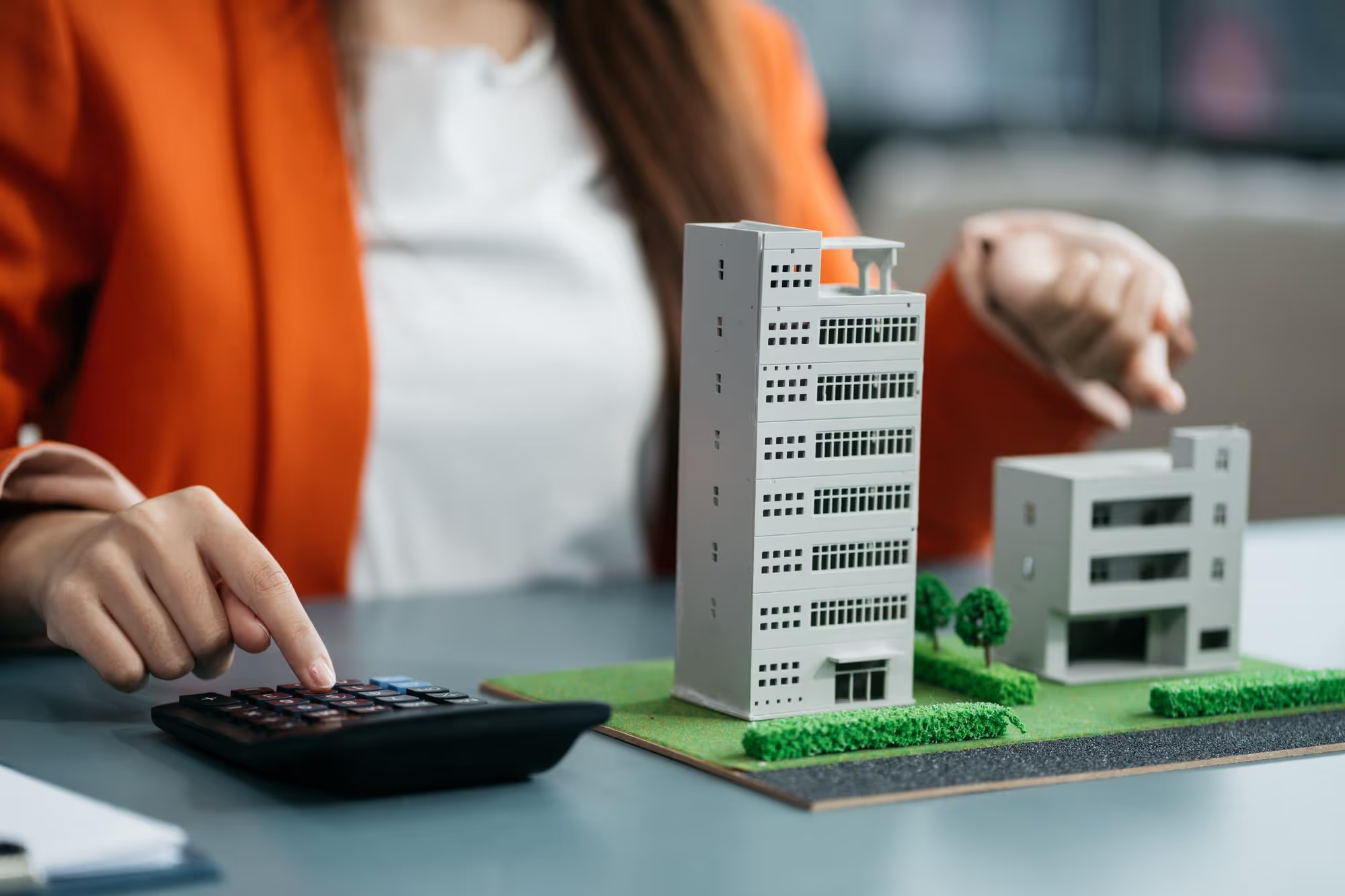

Across today's reality, the concept of investment property still resonates as a benchmark of financial freedom. But 2026 brings different prices, different lending conditions, and new rules. When does an investment flat pay off — and when might it turn into nothing more than an expensive bet on optimism?
The logic goes like this: I have spare money, I buy a flat, and the tenant gradually pays it off.
Part of the market is drawn by the word "passive"; others relish the thought of money arriving in their account on its own. But with interest rates around 5%, the answer to whether to buy a flat is no longer as clear-cut as it used to be.
Obstojí investiční nemovitost pořízená v roce 2026?
Will an investment property purchased in 2026 hold up?
An investment flat makes sense if you view it as a long-term asset (a horizon of 10 or more years), or if your motivation is passing it on to your children. In this context, property returns to its role as a family asset that preserves capital value.
A rational choice is to invest in a good location — major cities, cities with steady demand for rental housing (university towns), or areas with a strong employer.
The counterargument is a reminder that an investment flat is not a home to which you attach a certain sentiment and overlook certain things — it is a financial instrument.
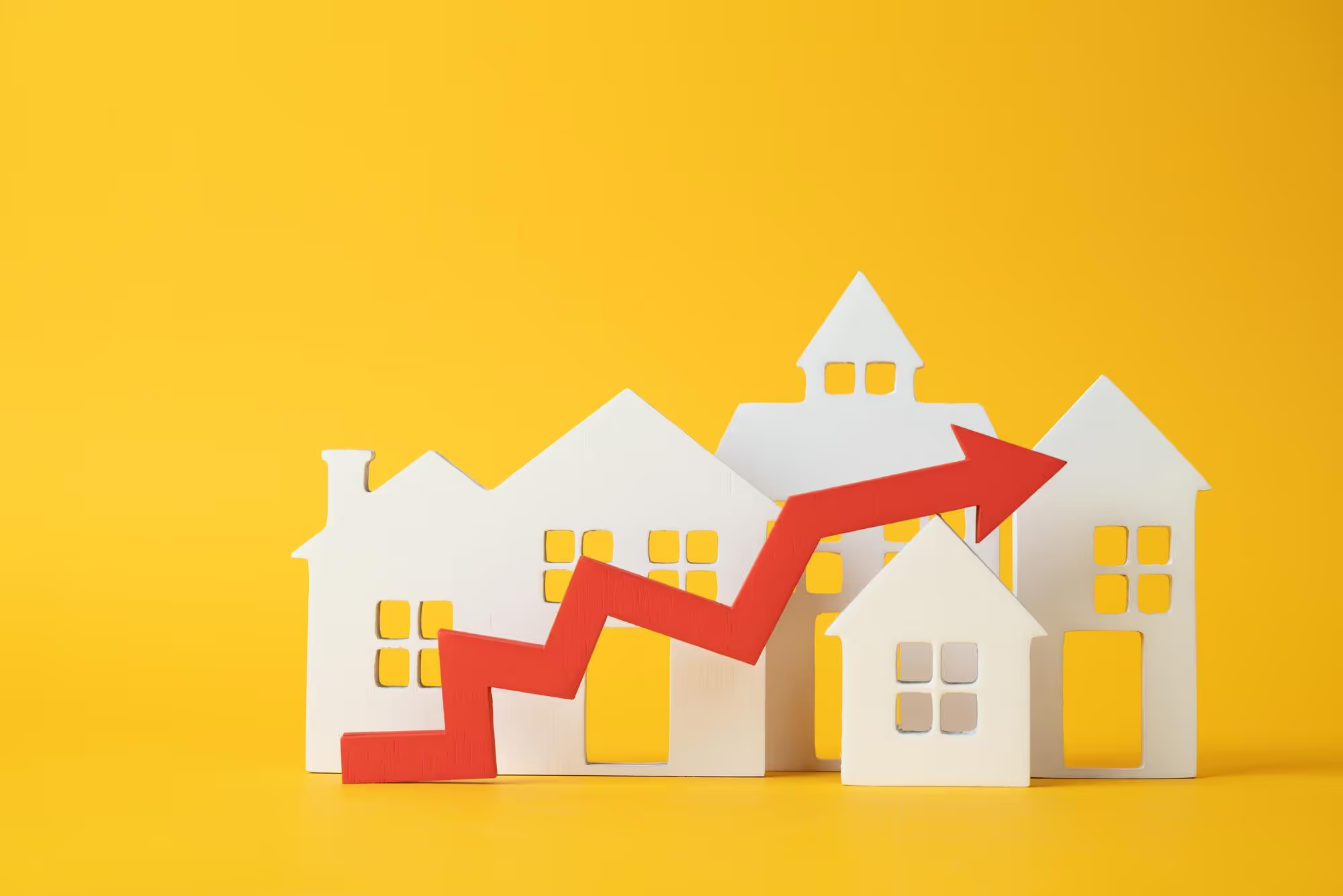
Investment properties must make economic sense as a financial instrument.
In basic investment thinking, an investment property rests on two main pillars:
At current property prices, with a similar price base, an interest rate of around 5% gets very close to the gross rental yield — which puts the idea of a money machine in a rather different light.
Investment mortgage vs. own funds
The key investment question is: Will you finance with a mortgage, or buy with your own money?
If you plan to use an investment mortgage, do the maths first so you don't trap yourself. The topic of investment flats often confuses two aspects:
This answers a simple but important question: Can I afford it each month? But the answer tells you something about cash flow, not about the investment itself.
Whether an investment flat stacks up as an investment depends on a different comparison: Rental yield versus interest rate — i.e. the cost of the money used to buy the flat. This is where you see whether the property is actually making money, or merely holding its value at a high cost of capital.
The second point cannot be ignored. Gross rental yield and interest are both calculated as a percentage of the same property price — and in many locations today, these two figures have converged significantly, sometimes even crossing.
In many major cities, we find that gross rental yield runs at roughly 3.5–5% per year, while new mortgages at the start of 2026 are averaging around 5%.
An investment flat is therefore no longer an automatic bet on a positive outcome — it now requires precise calculation, realistic expectations, and a clear answer to whether the investor aims to earn from rent, from capital appreciation, or from a combination of both.
Browse the property listings Investment plan or a ticking time bomb?
Investiční plán nebo časovaná bomba?
The reason rental yields and interest rates have converged so closely today is simple: property prices are rising faster than rents.
According to the Czech Statistical Office, the average price of a flat in the Czech Republic is around CZK 95,000 per m², in Prague approximately CZK 150,000 per m² — and growth continues and is likely to persist.
Want to stay informed? Read: What to expect from the real estate market in 2026?
Czech National Bank regulations
New regulations coming into force in April 2026 will also shake things up. For a third and each subsequent property, banks will typically require higher equity and will scrutinise income more strictly, which will further increase entry costs.
Combined with an environment where rent often barely covers the financing costs alone, very little margin is left for operating expenses, repairs, sinking fund contributions, or periods without a tenant.

Layout and location are decisive
In terms of profitability, smaller second-hand one-room flats currently tend to outperform new builds or large units, especially if they are well maintained and in a good location.
When assessing an investment, however, it's not enough to look at rental yield alone. Equally important is capital appreciation — i.e. the ability of a given location to hold its value over time and its "resilience".
The key question is therefore how a specific city or area will behave during economic downturns and whether it can maintain its value in the long run.
The picture of the future is also shaped by supply . The decline in completed new flats in recent years suggests that pressure on housing affordability is not going away — which may continue to support both prices and rents, while also raising the stakes of choosing the right investment.
Considering selling a property? Find out why a quality price estimate is the key to success .
A model example
Let's take a model example of a typical investment flat in Prague: a 60 m² flat at CZK 150,000/m² comes to a total purchase price of CZK 9,000,000.
At a market rent of CZK 460/m² per month, the rental income is CZK 27,600 per month, or CZK 331,200 per year. The gross rental yield thus comes to approximately 3.68% per year.
If the flat were financed primarily through a mortgage — say at 70% LTV — the loan amount would be approximately CZK 6.3 million. At an interest rate of around 5%, the annual interest cost alone would be approximately CZK 315,000. After adding other operating costs associated with ownership, the net annual result comes very close to zero or slightly negative.
Calculation: mortgage vs. own funds
On the mortgage financing side, the picture is sober. At 70% LTV and a 5% interest rate, the annual interest on a loan of CZK 6.3 million is approximately CZK 315,000.
Once further real costs are added — such as sinking fund contributions, property management, maintenance, or vacant periods — the total annual investment result turns negative or hovers on the edge of economic viability.
When financing from own funds, on the other hand, there is no interest cost. Annual rental income on the same parameters amounts to CZK 331,200, from which regular operating expenses must be deducted.
After deducting these, the net annual result is positive, but relatively modest in relation to the total capital invested. In this model case, the economics of the investment are rational primarily over the long term, with stable rental income.
An investment flat pays off today above all for those who enter with high equity (at least 30%) and are not fully dependent on a mortgage. It works well in a location with long-term, strong and stable rental demand and a low risk of vacancy.
An investment flat pays off today above all for those who enter with high equity (at least 30%) and are not fully dependent on a mortgage. It works well in a location with long-term, strong and stable rental demand and a low risk of vacancy.
In summary
- Investment property today generally makes economic sense primarily for investors with a long-term horizon and possibly a plan for intergenerational transfer.
- It makes sense for those with a higher share of equity and clarity about the role of property in their overall investment portfolio.
- For many people in the Czech Republic, property also remains one of the few comprehensible ways to preserve capital — not just for its stability, but also because alternative investment routes are often perceived as more complex or less trustworthy.
- On the other hand, investment in property can be risky for those entering with minimal reserves and underestimating the costs of expensive financing.
- With a disadvantageous loan, rental income can very quickly become more of a means of repaying debt than a source of returns — effectively an unwitting self-penalisation for paying off someone else's asset.